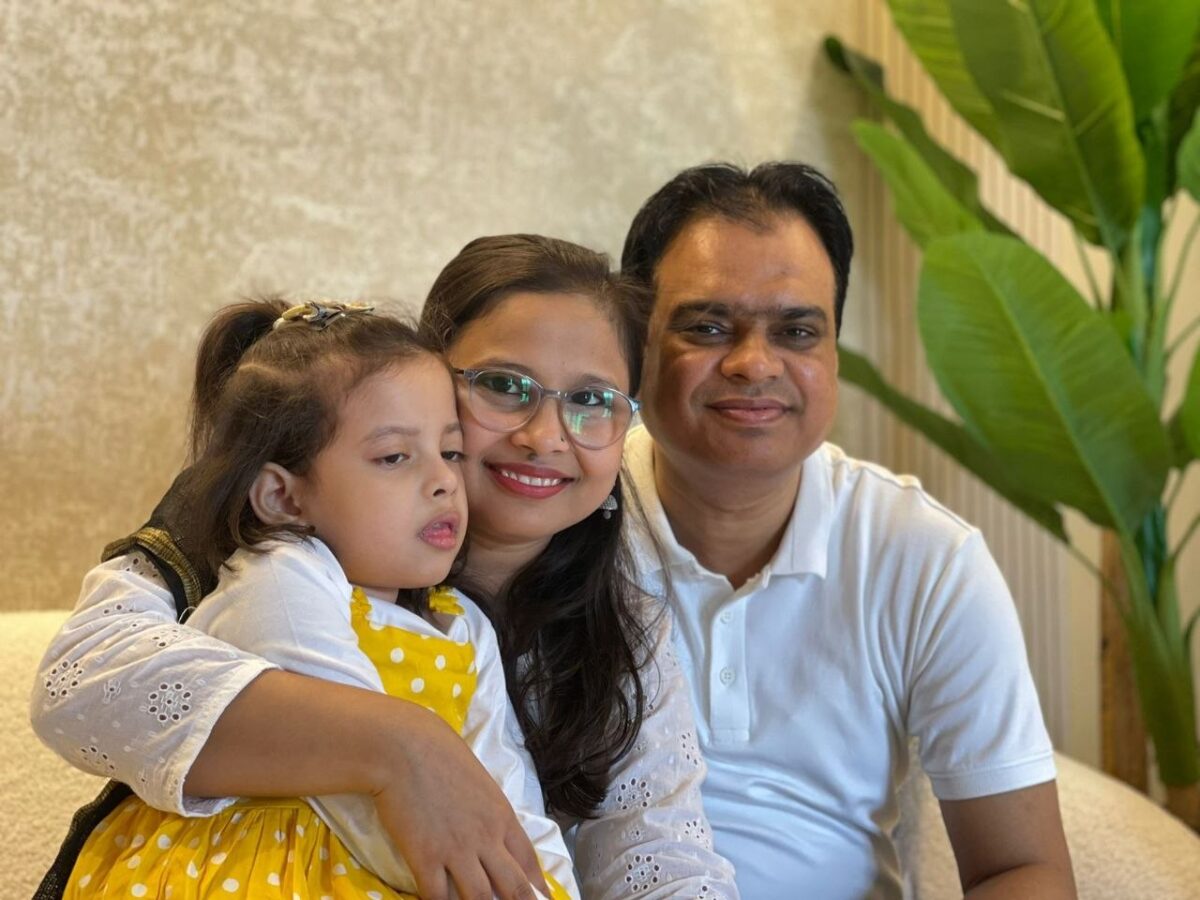

In the bustling city of Delhi, Ghuncha and Md Kashif Reza began their life together in 2016. Kashif worked as a mechanical engineer, and Ghuncha was a psychologist. They were blessed with a baby girl, Aizah Reza, in 2018.
For the first two and a half years, Aizah was a typical active child. She was running, talking, and even attending online play school during the pandemic. But by mid-2021, the world began to shift for the family. Ghuncha, who worked as a psychologist and had experience with kids on the autism spectrum, began to notice things that others might have missed.
“During the time of Eid in 2021, we noticed she was not achieving her milestones. She appeared to be slower than her peers. I felt she was not active. She was not running fast. I thought I was not able to give her time because I had started to work as a graphic designer, and that was why she was not active. I brushed it off at that time, thinking she was developing at her own pace and it was just a normal variation,” said Ghuncha.
By August, the physical signs became more obvious. Aizah suffered from repeated colds and an enlarged abdomen. While neighbors told them a “big tummy” was normal for toddlers, a senior pediatrician discovered that her spleen was enlarged. Her initial blood investigations were normal. She was subsequently referred to a hematologist. A bone marrow test soon revealed foamy cells, suggesting a storage disorder. Doctors told her the possibility of Gaucher disease. Ghuncha, who wanted to expedite treatment initiation, tried to contact Sanofi (the manufacturer of the medicine for Gaucher disease). After contacting Sanofi and being directed to specialists at AIIMS Delhi, the family finally received a name for the disease they were fighting: Niemann-Pick Disease Type C (NPC).
The diagnosis was a crushing blow. There was no cure. Miglustat, a medicine that can slow the progression of diseases, was exorbitantly costly.
“The news came as a devastating one for us. We googled it and found that there is no good disease course-modifying treatment. Worst things were yet to happen. She developed a seizure when she was almost three years old in 2022. Till then, she was able to talk, but after the seizures, her disease progressed rapidly,” she added.
As the neuroregression took hold, the family’s daily life became a battle. Eventually, Aizah stopped talking and eating, requiring a nasogastric tube for feeding. Kashif and Ghuncha bought a car just to ensure they could transport her more comfortably.
While the disease was hard enough, the social isolation was worse. In India, genetic disease is often a deep-seated taboo, and the family feels the weight of society’s judgment. People stopped visiting their home. They were no longer invited to weddings. Even a well-known pediatrician suggested the condition was simply a result of their religion and cousin marriage.
“We heard comments like my child suffered this because I worked with kids with autism. The people stopped inviting us to social gatherings. Genetic disease is a big taboo, and people hide it. People stare when we go out. Once at the airport, a lady came and asked why I was traveling with my ‘cerebral palsy child. At the same time, I met some good human beings who stood with us through thick and thin. I have seen both sides of society.'”
Despite the stares, there were moments of grace. Ghuncha recalls a relative who would hold Aizah and let her drool on him without a second thought. But by early 2025, Aizah’s body could no longer keep up the fight.
The end came in the evening while Aizah was on life support.
“I remember the day when Aizah got her angel wings. Her BP was falling. My husband had gone out to get some medicines, and the doctors asked me to leave the HDU. I saw nursing officers rushing, and I understood something was wrong. I started to shiver, and I was chanting religious verses in a slow voice. I wanted her to be with me, but at the same time, I wanted her to suffer no more. I told God, ‘If her pain can be relieved only by taking her to heaven, please do that.'”
When the doctors told Ghuncha that Aizah had passed after a cardiac arrest, the heartbreak was mixed with a heavy sense of relief.
“I saw her. Her hands and feet were turning blue. Her eyes were not opening. I was broken, but somewhere I felt light because she doesn’t have to suffer from this disease anymore. Sometimes, I feel sad, I feel angry, I feel guilty. Sometimes I feel happy because I could live with her for whatever period she was alive.”
Aizah’s story didn’t end with her last breath. Ghuncha now works for the NPD India community, trying to ensure that other families don’t have to face the same isolation and stigma.
“I want to reduce the suffering of the families. I will be happy if I can change 1% of the suffering.”
Aizah’s life was not just a personal tragedy. It is the archetype of the struggle faced by thousands of families across India living with rare genetic diseases. For these parents, the burden of the illness is only half the battle. The other half is fought against a society that often lacks the empathy or the education to understand what they are seeing.
When a child is born with a condition like NPC, the parents are thrust into a world of “why us?” While they are navigating hospital corridors and learning to manage feeding tubes, the world outside often greets them with suspicion rather than support.
“As parents of a rare disease warrior, the journey was not only emotionally challenging, but it was financially, mentally, and even physically exhausting. We were constantly in a state of fight-or-flight, never knowing what the next moment might bring. That uncertainty always killed us. This journey with Aizah made us more aware, more empathetic, and stronger than we ever knew we could be.”
By sharing Aizah’s journey, we aren’t just telling the story of one “NPC Warrior.” We are demanding a world where families don’t have to hide their children, and where genetic conditions are met with medical support instead of religious or social judgment.
P.S. We have received explicit permission from the family to share Aizah’s story using their real names and images to help raise awareness for the NPC community.