
Introduction
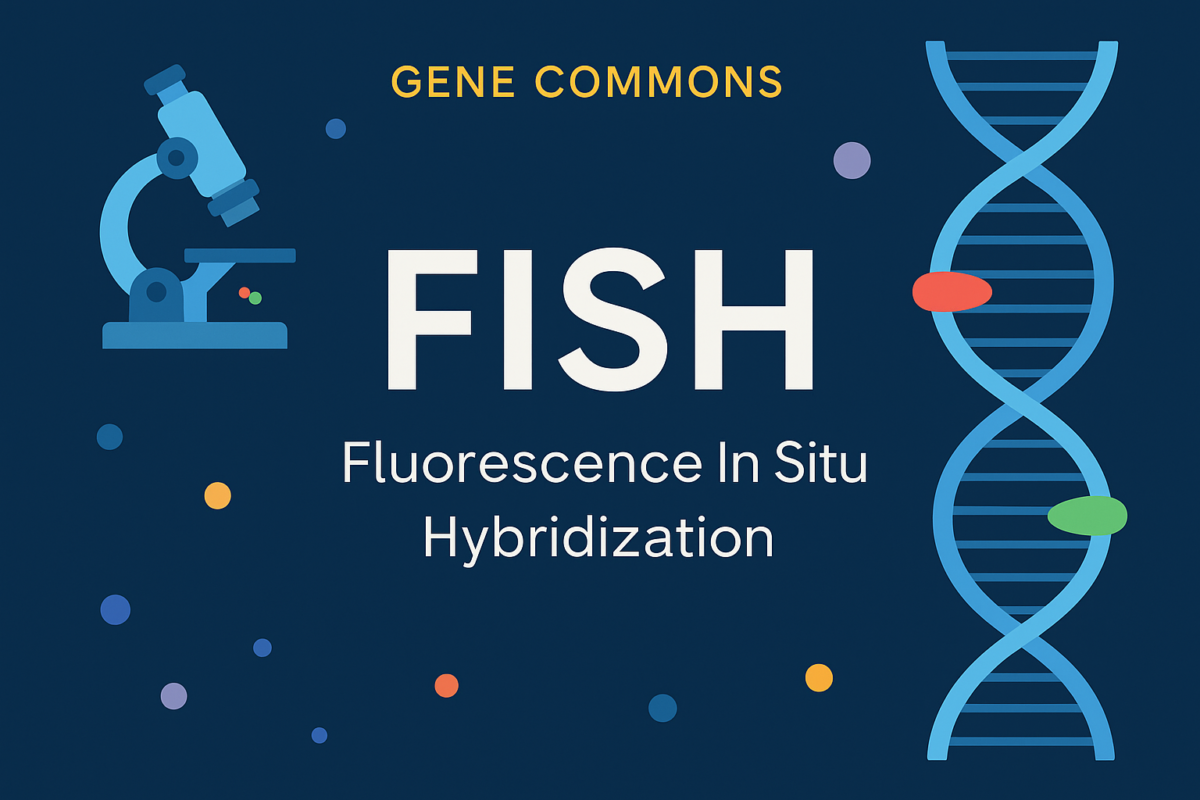
Fluorescence in situ hybridization (FISH) is a laboratory technique that allows scientists and clinicians to directly visualize and map the presence, absence, or location of specific DNA sequences on chromosomes or within nuclei. It bridges the gap between classical cytogenetics, which looks at whole chromosomes through banding patterns, and molecular genetics, which investigates DNA sequences in detail.
Unlike a traditional karyotype that depends on the pattern of G-bands to detect large chromosomal changes (usually >5–10 Mb), FISH can detect much smaller abnormalities (100 kb–1 Mb) with high specificity. The technique uses fluorescently labeled DNA fragments, known as probes, that are designed to bind to complementary DNA in cells. Once hybridized, these probes emit light of specific colors under a fluorescence microscope, making it possible to identify chromosomal gains, losses, rearrangements, or gene amplifications.
FISH is powerful because it can be performed both on dividing cells (metaphase spreads) and non-dividing cells (interphase nuclei), making it widely applicable in prenatal diagnosis, hematology/oncology, solid tumor pathology, and constitutional genetics.

Book
History and Evolution
The Beginnings: Radioactive In Situ Hybridization
The earliest versions of in situ hybridization were performed in the late 1960s. Gall and Pardue (1969) hybridized tritiated RNA to complementary DNA on chromosomes of Drosophila. The hybridization was visualized by autoradiography: the radioactive probe exposed a photographic emulsion, leaving behind silver grains that indicated binding.
This radioactive approach was groundbreaking but limited:
- Signals required days to weeks of exposure.
- Resolution was poor due to the “scatter” of radioactive decay.
- Safety issues arose with radioactive handling.
- High background noise made subtle signals difficult to interpret.
Transition to Non-Radioactive Methods
By the 1980s, researchers began using non-radioactive labels. Probes were tagged with biotin or digoxigenin (haptens), which could then be detected with fluorescent antibodies or avidin systems. This shift provided sharper signals, greater safety, and the ability to use multiple probes at once.
The Birth of FISH
The true revolution came when fluorescent dyes were directly conjugated to DNA probes. In 1986, Langer-Safer and colleagues demonstrated direct detection using fluorochromes. By 1988, Pinkel and coworkers applied FISH to detect trisomy 21 and chromosomal translocations. This made the technique clinically relevant.
FISH in the Modern Era
The 1990s saw the widespread adoption of FISH in clinical labs. New probe designs (centromeric, locus-specific, subtelomeric) were developed. Automation and digital imaging improved throughput.
More advanced versions like M-FISH (Multiplex FISH) and SKY (Spectral Karyotyping) were introduced, enabling the simultaneous coloring of all 24 human chromosomes. Specialized applications such as fiber-FISH provided high-resolution mapping of genes along DNA fibers.
Today, although microarrays and sequencing technologies dominate genome-wide testing, FISH remains indispensable as a targeted, confirmatory, and rapid assay.
Principle of FISH
The principle of FISH rests on the natural ability of DNA strands to anneal to their complementary sequence. The process involves the following steps:
- Sample preparation
- Cells (from blood, bone marrow, amniotic fluid, solid tissue, etc.) are harvested and placed on slides.
- For metaphase FISH, cells are arrested in metaphase (with colcemid) to visualize chromosomes.
- For interphase FISH, nuclei are sufficient.
- Cells (from blood, bone marrow, amniotic fluid, solid tissue, etc.) are harvested and placed on slides.
- DNA denaturation
- Both the chromosomal DNA (target) and the DNA probe are denatured into single strands, usually by heat or formamide.
- Both the chromosomal DNA (target) and the DNA probe are denatured into single strands, usually by heat or formamide.
- Hybridization
- The fluorescently labeled probe is applied to the denatured DNA.
- The probe binds (hybridizes) specifically to its complementary sequence.
- The fluorescently labeled probe is applied to the denatured DNA.
- Washing
- Non-specific binding is washed away under conditions of appropriate stringency (controlled by temperature, salt concentration, and formamide).
- Non-specific binding is washed away under conditions of appropriate stringency (controlled by temperature, salt concentration, and formamide).
- Visualization
- The slide is counterstained (commonly with DAPI, which stains all DNA blue).
- Under a fluorescence microscope with the appropriate filter sets, the probe’s color(s) are visualized.
- The slide is counterstained (commonly with DAPI, which stains all DNA blue).
- Interpretation
- The number, position, and pattern of fluorescent signals indicate whether the targeted region is normal, deleted, duplicated, or rearranged.
- The number, position, and pattern of fluorescent signals indicate whether the targeted region is normal, deleted, duplicated, or rearranged.
Types of Probes in FISH
FISH probes are the backbone of the assay. They are designed for specific diagnostic or research purposes. The main types include:
1. Centromeric (Alpha-Satellite) Probes
- Target repetitive DNA sequences at centromeres.
- Used to count chromosomes, detect aneuploidies.
- Example: Detecting trisomy 21, monosomy X, or polysomy in tumors.

Book
2. Locus-Specific Identifier (LSI) Probes
- Bind to a specific gene or chromosomal region.
- Used for microdeletions, duplications, or rearrangements.
- Example: ELN probe for Williams syndrome (7q11.23), HER2 probe for breast cancer, D22S75 probe for DiGeorge syndrome.
3. Fusion Probes
- Dual-color probes targeting two genes known to fuse in a specific translocation.
- Example: BCR-ABL (t(9;22)), PML-RARA (t(15;17)).
4. Break-Apart Probes
- Flank a gene’s breakpoint region; split apart when rearranged.
- Example: ALK break-apart probe in lung carcinoma, MLL (KMT2A) break-apart in leukemia.
5. Whole Chromosome Paints (WCP)
- A mixture of probes covering the entire length of a chromosome.
- Used for detecting structural rearrangements and marker chromosomes.

6. Subtelomeric Probes
- Target unique sequences just proximal to telomeres (70–300 kb from the end).
- Useful for detecting cryptic terminal deletions and rearrangements.
7. Telomere Repeat Probes
- Bind to (TTAGGG)n repeats at chromosome ends.
- Mainly research tools for studying telomere length and instability.
8. Multicolor Probe Sets
- Include multiplex FISH and SKY.
- Paint all chromosomes in unique colors, allowing genome-wide structural analysis.

Break-Apart and Fusion Probes
These two probe designs are especially important in oncology cytogenetics.
Fusion Probes
- Design: Two different-colored probes, each binding to a different gene partner.
- Normal cells: 2 red + 2 green signals (separate).
- Abnormal (fusion): When genes fuse, red and green overlap → yellow fusion signal.
- Types:
- Single-fusion probes: Produce one fusion signal (e.g., BCR-ABL single fusion).
- Dual-fusion probes (DCDF): Produce two fusion signals (one on each derivative chromosome).
- Single-fusion probes: Produce one fusion signal (e.g., BCR-ABL single fusion).
Examples:
- BCR-ABL (Philadelphia chromosome, CML).
- PML-RARA (APL).
Break-Apart Probes
- Design: Two different-colored probes placed on either side of a single gene’s breakpoint.
- Normal cells: Probes sit close → appear fused (yellow).
- Abnormal cells: If gene is rearranged, probes separate → red and green split apart.
Examples:
- ALK rearrangements in lung cancer.
- MLL/KMT2A rearrangements in leukemia.
- MYC rearrangements in lymphoma.
Key difference
- Fusion probes detect when two known partners come together.
- Break-apart probes detect when one gene splits, regardless of partner.
Uses of FISH
FISH is widely used in clinical practice and research. Its versatility lies in being applicable to many sample types and answering specific genetic questions.
1. Constitutional (Genetic Disorders)
- Aneuploidy detection: Rapid prenatal diagnosis of trisomy 13, 18, 21, X, and Y using centromeric probes.
- Microdeletion syndromes:
- DiGeorge syndrome (22q11.2 deletion).
- Williams syndrome (7q11.23 deletion).
- Prader-Willi/Angelman syndromes (15q11-13).
- Smith-Magenis, Miller-Dieker, etc.
- DiGeorge syndrome (22q11.2 deletion).
- Cryptic rearrangements: Subtelomeric probes reveal hidden translocations/deletions causing unexplained developmental delay/ID.
2. Hematology/Oncology
- Leukemias and lymphomas:
- BCR-ABL (CML, ALL).
- PML-RARA (APL).
- MLL rearrangements (AML, ALL).
- IGH translocations (multiple myeloma, lymphomas).
- BCR-ABL (CML, ALL).
- Solid tumors:
- HER2/neu amplification in breast cancer.
- ALK rearrangements in lung carcinoma.
- MYC rearrangements in Burkitt lymphoma.
- HER2/neu amplification in breast cancer.
3. Solid Tumor Pathology
- FFPE samples can be used after deparaffinization and pretreatment.
- Helps in therapeutic decision-making (HER2 FISH for trastuzumab therapy).
4. Research
- Gene mapping: Locating new genes on chromosomes.
- Evolutionary biology: Comparing synteny across species.
- Telomere studies: Measuring telomere shortening in aging or cancer.
- Chromosome architecture: Fiber-FISH provides high-resolution mapping of DNA along fibers.
5. Advantages of FISH
- Works in dividing and non-dividing cells.
- Faster than karyotype (results in 1–2 days).
- Higher resolution (detects submicroscopic abnormalities).
- Multiplex capability (several probes in one assay).
6. Limitations of FISH
- Targeted: can only detect what you probe for.
- Not genome-wide (microarray/NGS provide broader analysis).
- Probe cost and need for fluorescence microscopy.
- Signal fading over time.
Conclusion
Fluorescence in situ hybridization is a cornerstone of modern cytogenetics. From its origins in radioactive autoradiography to today’s multicolor probe sets, FISH has evolved into a powerful diagnostic and research tool. By combining molecular specificity with visual clarity, it allows detection of aneuploidies, microdeletions, duplications, and oncogenic rearrangements that would otherwise remain hidden.
While chromosome microarray and sequencing methods have taken over many first-line applications, FISH remains indispensable for rapid targeted testing, confirmation of array findings, and characterization of structural rearrangements.
Join Our Google Group
Join our google group and never miss an update from Gene Commons.
Join Google GroupDisclaimer
Genecommons uses AI tools to assist content preparation. Genecommons does not own the copyright for any images used on this website unless explicitly stated. All images are used for educational and informational purposes under fair use. If you are a copyright holder and want material removed, contact doctorsarath@outlook.com.



Thanks for this informative article