
The Need for Smarter Variant Interpretation
As genome sequencing becomes routine in clinical practice, one major challenge remains: interpreting the significance of the millions of genetic variants found in each person. This is particularly difficult for missense mutations, where one amino acid is replaced by another in a protein. These can be harmless or cause serious diseases, but in most cases, their impact is uncertain. These are labeled variants of uncertain significance (VUS).
Traditional tools rely heavily on conservation scores, biochemical rules, or expert annotation. However, they often fail to accurately classify rare mutations or provide scalable solutions for large datasets. To address this, researchers at Illumina, a biotechnology company based in the United States, developed PrimateAI in 2018, in collaboration with researchers from Stanford and other institutions. This tool was published in Nature Genetics (Sundaram et al., 2018). PrimateAI offers a new approach to variant classification using real-world evolutionary data and modern AI architecture.
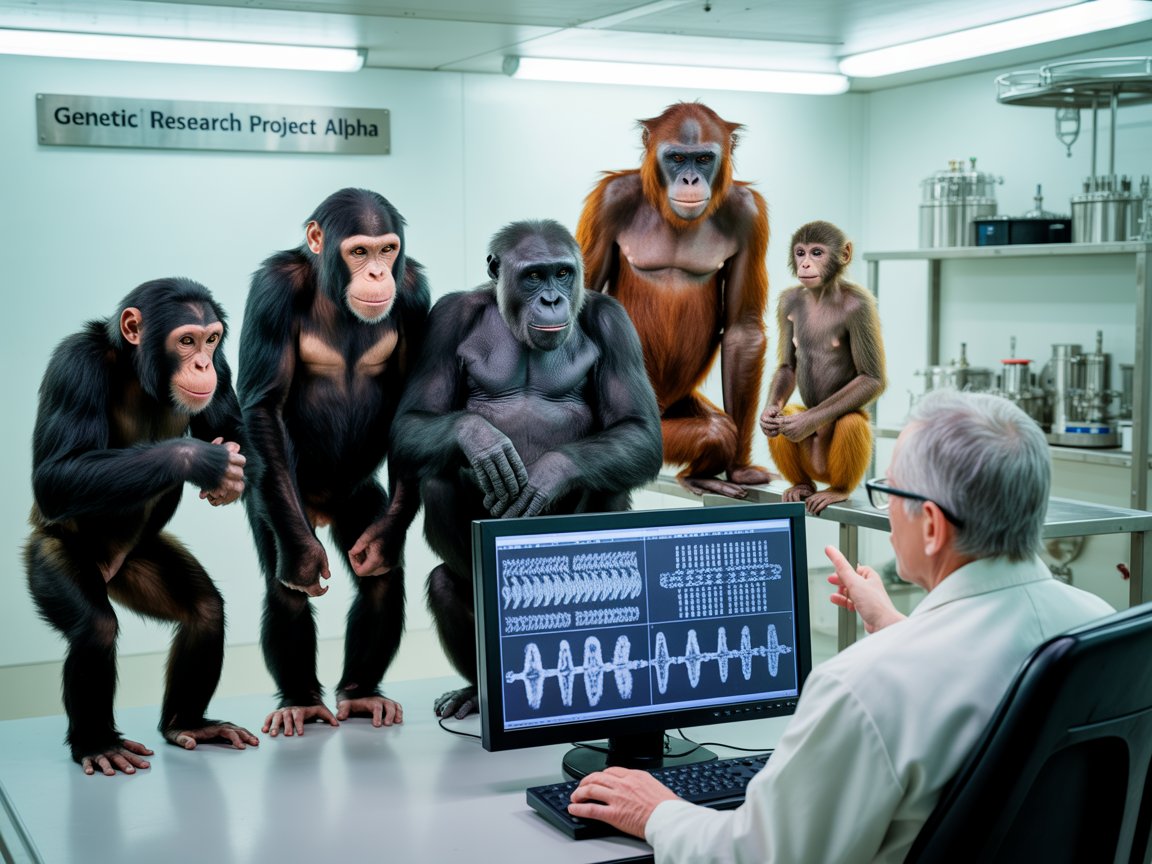
Humans and chimpanzees share nearly 99.4% of their amino acid sequences. This remarkable similarity suggests that the evolutionary constraints acting on chimpanzee protein-coding sequences are also highly relevant to humans. Therefore, if a mutation is tolerated in chimpanzees, it is likely to have similar effects in humans, making them an ideal model for understanding the impact of human genetic variation.
What is PrimateAI?
PrimateAI is a deep residual neural network designed to predict whether a missense mutation is likely pathogenic (disease-causing) or benign (harmless). It was trained on approximately 380,000 common missense variants found in humans and six non-human primates. These real-world variants are assumed to be mostly benign because they occur in healthy individuals and have been preserved by evolution.
Unlike earlier tools, PrimateAI does not depend on human-annotated features. It learns directly from:
- The amino acid sequence surrounding the mutation,
- Multiple sequence alignments (evolutionary comparison) across species,
- Predicted aspects of protein structure.
The model outputs a score from 0 (likely benign) to 1 (likely pathogenic).
Training Data and Evolutionary Insight
PrimateAI’s strength lies in its evolutionary grounding:
- It uses real variant data from six non-human primates: chimpanzee, bonobo, gorilla, orangutan, rhesus macaque, and common marmoset.
- It incorporates conservation data from 99 vertebrate species to determine how conserved (important) each position in the protein is.
| Data Type | Species Count | Purpose |
|---|---|---|
| Common variant training | 6 primates | Real examples of benign variation |
| Conservation analysis | 99 vertebrates | Measure evolutionary constraint |
This two-tier approach helps the model distinguish between theoretical conservation and actual biological tolerance.
Handling Conflicts: When Real Data and Conservation Disagree
If a mutation occurs in a highly conserved site (usually considered important) but is also common in healthy primates, PrimateAI is designed to lean toward real-world data. In other words, if nature has tolerated this change in primates over millions of years, it’s likely benign, even if theoretical conservation would suggest otherwise.
How the Model Works: A Simplified Look at the Architecture
The input to PrimateAI is:
- A 51-amino-acid window around the mutation,
- Three Position Frequency Matrices (PFMs) derived from the 99-species alignments: one for primates, one for other mammals, and one for non-mammalian vertebrates.
This creates five main input channels:
- The original (reference) protein sequence
- The mutated (alternate) sequence
- Evolutionary conservation scores from primates
- From non-primate mammals
- From all other vertebrates
The model uses two parallel tracks: one for the reference sequence and one for the alternate sequence. These tracks are processed through a deep series of convolutional layers and residual blocks (36 layers in total), which allow the network to learn detailed functional impacts.
At the final stage, the outputs from both tracks are merged, and a global max pooling layer condenses the information into a single pathogenicity score.
Incorporating Protein Structure: More Than Just Sequence
To improve prediction accuracy, PrimateAI includes two additional deep learning models:
- Secondary structure predictor: Identifies if the amino acid is in an alpha-helix, beta-sheet, or coil.
- Solvent accessibility predictor: Predicts whether the residue is buried inside the protein or exposed.
These models were pre-trained using known 3D protein structures from the Protein Data Bank (PDB). Their internal representations are directly fed into the main PrimateAI model. This gives the network a better sense of how a mutation might disrupt a protein’s folding or interaction with other molecules.
Clinical Utility and Access
PrimateAI is available for use via:
- Illumina BaseSpace platform
- GitHub: https://github.com/Illumina/PrimateAI
It provides precomputed scores for over 70 million variants and is already being used in rare disease gene discovery and clinical interpretation of variants.
Although newer tools such as EVE, AlphaMissense, and PrimateAI-3D have been developed with enhancements in data, structure, and modeling, the original PrimateAI remains influential and continues to be used as a foundational model in variant pathogenicity prediction. These newer tools build upon similar concepts and often outperform older models, but PrimateAI still holds value due to its interpretability, evolutionary rationale, and integration in clinical platforms.
Conclusion
PrimateAI represents a significant leap forward in variant interpretation. By combining deep learning, evolutionary biology, and structural bioinformatics, it provides a powerful, data-driven tool for distinguishing harmful from harmless missense mutations. Its design avoids over-reliance on manual features and instead lets the data speak for itself, using the genetic history of primates and vertebrates as a natural filter.
Reference:
Sundaram, L. et al. (2018). Predicting the clinical impact of human mutation with deep neural networks. Nature Genetics, 50(8), 1161–1170. https://doi.org/10.1038/s41588-018-0167-z
Disclaimer
Genecommons uses AI tools to assist content preparation. Genecommons does not own the copyright for any images used on this website unless explicitly stated. All images are used for educational and informational purposes under the doctrine of fair use. If you are a copyright holder and want material removed, contact doctorsarath@outlook.com.
Join Our Google Group
Join our google group and never miss an update from Gene Commons.